I have been asked by one of my readers to post some progress photos on my verge garden that I started during Covid. Since my verge garden is pretty plain, even plainer than in the first year or two that I planted it out, I will extend this show-and-tell to another small patch of my front yard that I have been giving a makeover.
The verge garden has had some setbacks with several plants finding the conditions too harsh/cold/hot/wet/dry, etc. The central feature of my verge garden is the brittle gum (E. mannifera). Brittle gums are difficult trees to grow anything under, especially plants that come from Western Australia, which is on the other side of Australia from where I live. So, duh, I shouldn’t have been surprised by the outcome. So, I’ve found some plants that like to grow under brittle gums and they are going well. Let’s take a look.
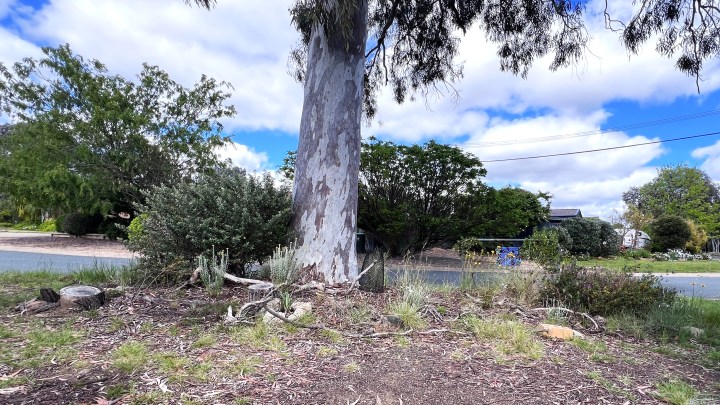
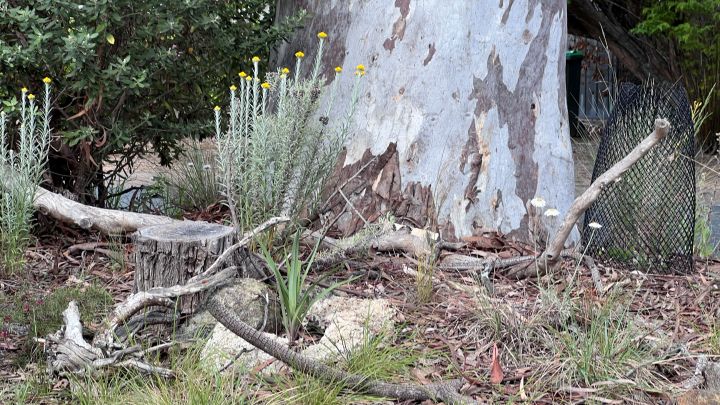
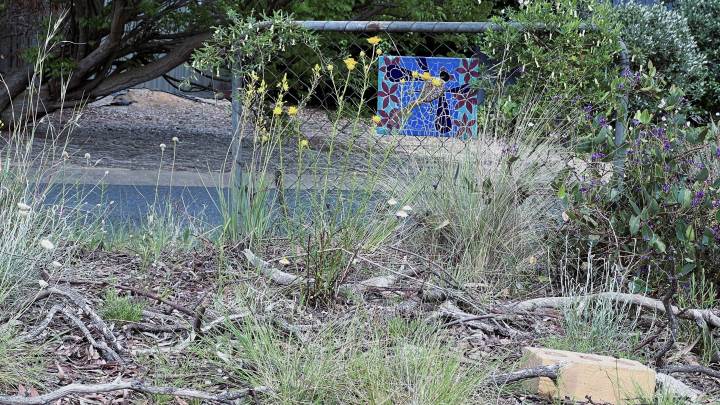
I’m being hyper-critical. If I was to come across a patch like this under a brittle gum in the bush, I would be delighted. So I’m delighted. Still, six years is a long time to see results.
Keeping with the natural bush theme and planting of locally indigenous plants, I decided to hack out the kikuyu in the front yard. I’ve been working on this for three years now and I’ve only rehabilitated a few square metres. It is one thing to work to improve a patch of woodland that already has an understorey of native plants. Nature is a great artist and she guides the way. However, it is more challenging to create a grassy woodland understorey from scratch, especially without a plan. Voilà the current state of gardening play –
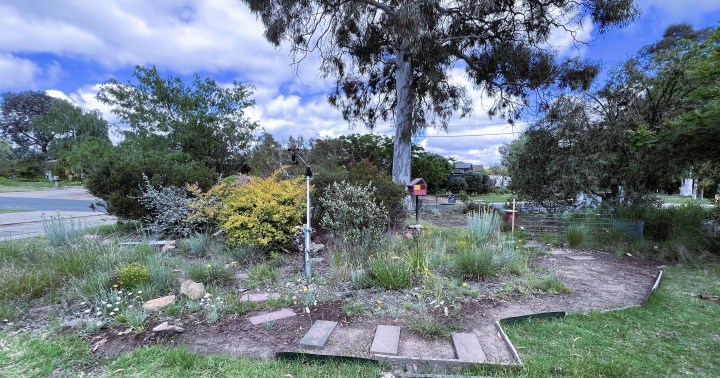
I started with a couple of existing tussocks of kangaroo grass (Themeda triandra) and a few wallaby grasses that I began to work around, clearing the kikuyu and other weeds. The plan is to gradually push back the exotic grass.
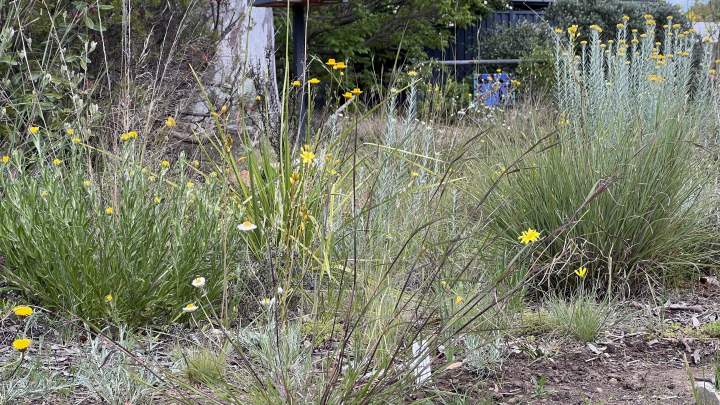
Two years ago I planted out the area below. It is very grassy now. I love it.
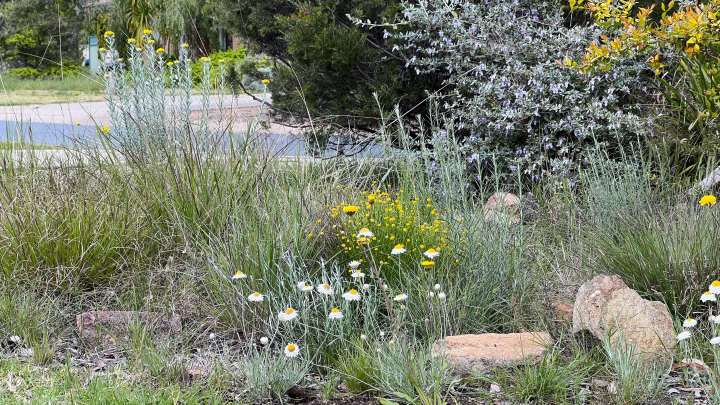
Then I started on the following area last winter and the current spring.
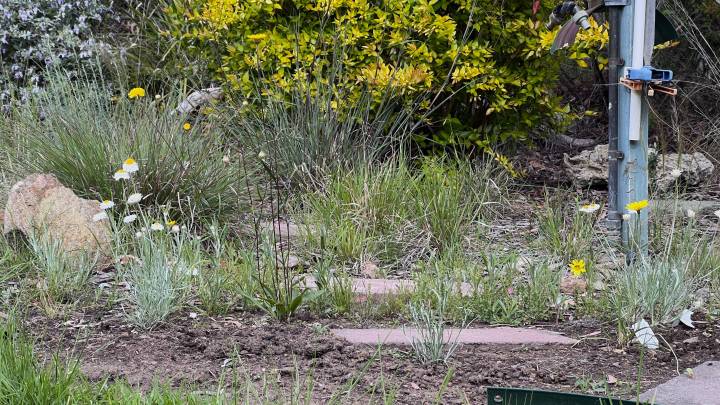
I’m thinking of moving to my twilight home. You know, the one with less yard. No one appreciates this type of garden so when we sell the house, no doubt someone will scrap the native garden and replace it with viburnum hedges and whatever else is the current fad. In the meantime, I need something to do so I will keep improving biodiversity in my own yard. Every little bit helps, especially these days.
Do you have a project to keep you sane and leave the world a little better off? If not, perhaps start something, or plant something, small and watch it grow. I highly recommend it.
Take care, everyone.
Kind Regards.
Tracy.


Thanks for posting an update on your verge garden, Tracy. I love the rustic wild look of the grasses and hope they will continue to grow under this variety of gum tree. Your patience must be wearing very thin 6 years down the track, but I’m sure you’ll eventually succeed (even if it’s just as you move house LOL).
I’m a big fan of grasses, especially the indigenous ones even if I don’t know much about them. The Royal Botanic Gardens here in Melbourne had some fine grass beds I photographed when I lived 2 streets away before I moved to the western suburbs in 2016. Actually, it’s almost 10 years to the day since I moved to Maribyrnong, 10+ kms west of Melbourne. I was looking at photos I first took on the 19th October 2016 earlier today. (My blog is on hold until I recover from a bad fall in February this year and get cataract surgery early 2027 (I hope).
I remember my Father tackling the Kikuyu with never-ending patience in our old family home front yard. It seemed to be a task he actually enjoyed, and if I had a standalone house with a yard (instead of an apartment with a balcony), I’d bet I’d be the same (if I could bend/turn/kneel after this hip replacement of mine). I have the patience of a saint when it comes to fine details – cleaning or clearing.
LikeLiked by 4 people
Vicki, I’m sorry to hear you took a tumble. I can relate. Hopefully once you have your cataract surgery, you will be able to get back into your photography. The time will pass quickly.
My garden is a classroom. I’ve learnt a lot which will hopefully save time on other projects. The rabbits have mysteriously disappeared which has been such a relief. Perhaps someone or something ate them.
LikeLiked by 1 person
So interesting! It’s so different from what I had imagined, which was more enclosed and – er – cooped up. You’re doing a pretty good job here, Tracy!
LikeLiked by 4 people
It was cooped up, Margaret. I’ve just removed the rabbit fence and it looks soooooo much better. Touchwood the rabbits have gone.
LikeLiked by 3 people
Slow and steady wins the race. Your garden is coming along nicely. Someone may love your home just because of the biodiverse yard!
LikeLiked by 6 people
I hope so, Heather. We shall see.
LikeLiked by 2 people
I think it’s beautiful. I also agree with Heather. That lovely patch might be a selling point.
LikeLiked by 4 people
Fingers crossed, Martha. If only the inside of the house looked as good. 🙂
LikeLiked by 2 people
Fingers crossed!
LikeLiked by 2 people
Thank you for sharing your progress with your verge garden!
LikeLiked by 4 people
It truly was my pleasure, Liz. I’m really thrilled with it. Why didn’t I do this before?
LikeLiked by 3 people
😊
LikeLiked by 2 people
What a breathtakingly honest and inspiring garden update, Tracy! Watching those native grasses fill in under the brittle gum is such a rewarding journey.
LikeLiked by 2 people
Thank you for commenting. It fills the time pleasantly.
LikeLiked by 2 people
It looks good. I’m trying to grow a garden on the Fleurieu Peninsula in South Australia. We don’t get much rain and have lots of rabbits. Quite a challenge. As your post shows it’s about persevering.
LikeLiked by 2 people
It is hard to establish gardens, especially native gardens with rabbits. They seem to prefer delicate Australian plants. Couldn’t resist investigating whether there are Landcare or an Australian Plant. Society group on the Fleurieu Peninsula. Of course there are. All the best.
LikeLiked by 2 people
Thanks for the update, Tracy. Six years is a long game, but swapping in plants that suit life under a brittle gum seems to be paying off. I also like that you’re working with what’s already there, starting from the kangaroo grass tussocks and pushing the kikuyu back a little at a time. Slow, patient restoration like that adds up, and I hope the next owner appreciates it. Good luck with the vanilla lily!
LikeLiked by 2 people
Thanks so much for your encouragement, Gerard.
LikeLiked by 1 person
Xxx
LikeLiked by 3 people