Who knew that watching the grass grow and grow was so interesting?
I’ve written a thousand blog posts in my mind over the last couple of months. I’m usually down the park at the time undertaking landcare activities (aka weeding). One of our team members described me as indefatigable. Sure, I can spend five or six hours weeding in oppressive heat but I don’t feel indefatigable. I feel exhausted. Many a time I have just wanted to lie down under a tree and have a sleep. The ants would like that. I think anxious would be a better term to describe me rather than indefatigable.
The hot, humid conditions and the shutdown over the Christmas break has led to an even greater explosion of African Love Grass (Eragrostis curvula) across Canberra (Australia). African Love Grass consumes all other grasses in its path and is highly flammable. So yeah, I am focussed on weeding as much of it out as quickly as I can so that the native grasses can provide it with some competition, improve biodiversity and mitigate fire risk. I’m not doing this alone by any means. Do you think I want to kill myself? Fortunately, our urban park has also been designated a conservation zone because it contains a patch of critically endangered box gum grassy woodland and hence a native grass-friendly mowing program has recently been established for it. Without that change to the mowing regime, there would be no hope of containing that Love Grass.
Australian native grasses are touted as a way of mitigating the fire risk of African Love Grass. A patch of Themeda triandra (below) holds the moisture in the ground. It can compete against Africa Love Grass in sunny aspects given a modified mowing program and some TLC. This patch took much weeding and new mowing arrangements to bring it back to match fitness. Themeda triandra is native to Australia, Asia and the Pacific.
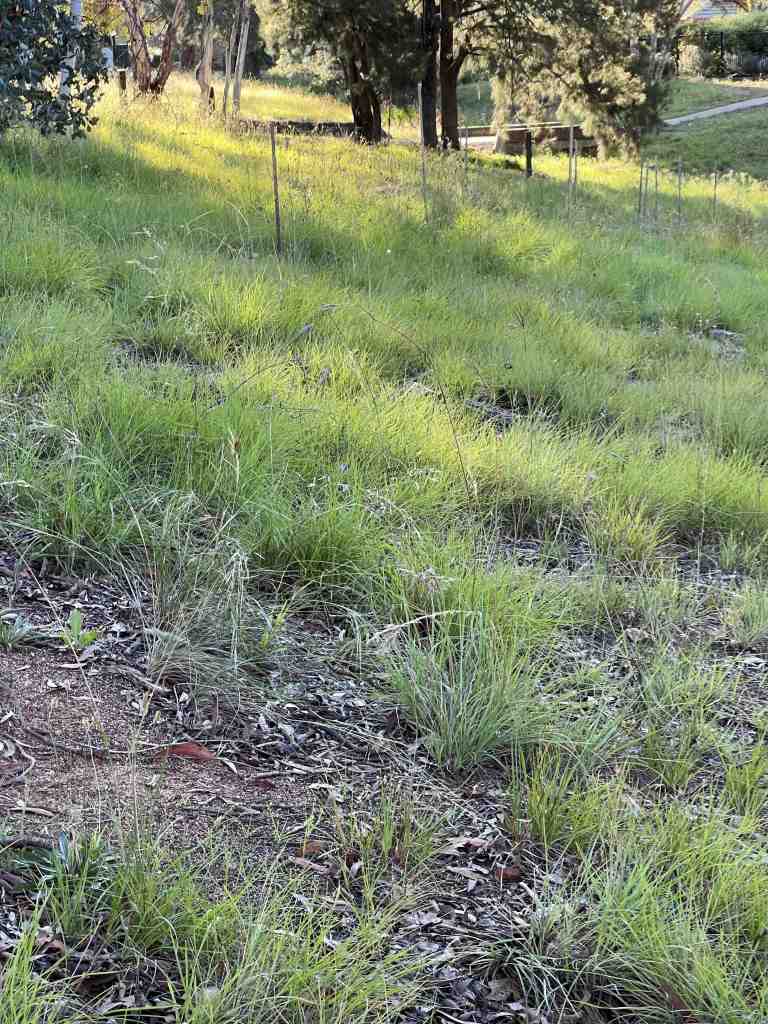
African Love Grass is not a fan of shade. In the shade, our lovely weeping grass (Microlaena stipoides) can put a break on it and other tall, weedy exotic grasses.
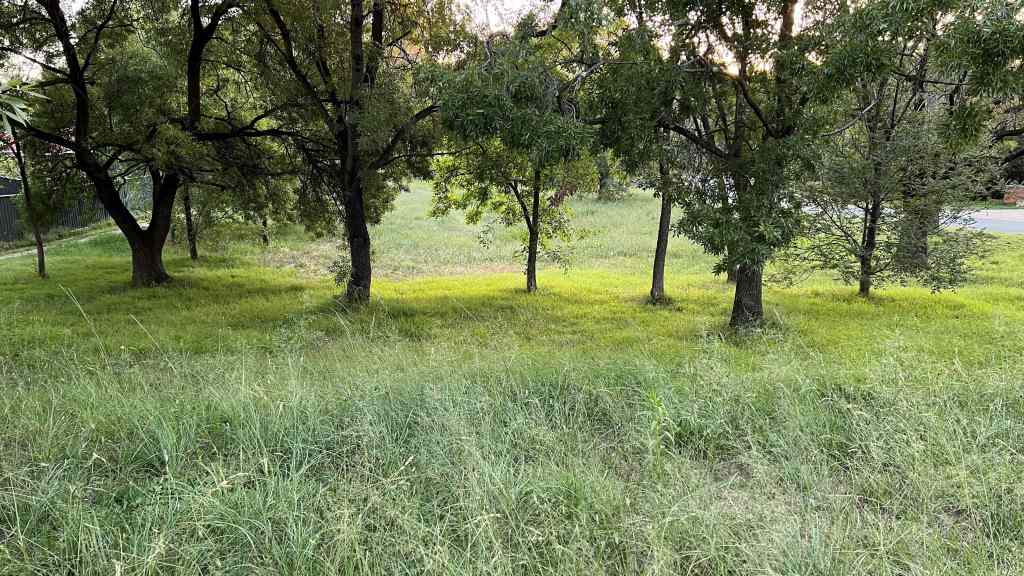

Not mown, except by kangaroos, completely surrounded by exotic weeds.
Unfortunately, the general population doesn’t appreciate the distinction between native grass and weedy grasses like African Love Grass (ALG), Chilean needle grass and serrated tussock. Except for the Rural Fire Service, who would know this stuff? I certainly didn’t know until I started my landcare activities. Moreover, what government is going to admit to the fire hazard in the heart of our city? There is no asset protection when ALG is allowed to grow unchecked across Canberra. That’s my personal view. Our local government must indeed be worried. When hot dry winds are predicted, one can hear the constant buzz of municipal lawn mowers racing to slash the grass across the city. But mowing in those conditions can also be a hazard. Late last year, one of our landcare members saw a mowing crew trying to stamp out a grass fire started by their mower on a hot and windy day. Scary. Thankfully the fire was on a median strip.
It must a real conundrum for the government on how best to educate people about the fire mitigating properties of native grasses without encouraging lunatic fire bugs to take advantage of our city’s vulnerability. It would be a brave government that would try that. Instead, governments and oppositions exhort the benefits of increased mowing even though this is to the detriment of any native grasses that might be just hanging in there. Nuance and politics don’t go together. I feel their pain. It is really not practical or economic to massively scale up the sort of weed reduction and rehabilitation efforts that many of Canberra’s landcare teams are undertaking. Nevertheless, call it biodiversity protection, call it landcare, call it what you will, educating people about our local grassland assets and their care can benefit us all by at least starting a conversation on what can be achieved with community support. At the very least, people may be more inclined to mow their ALG infested yards.

Thanks for reading this far. I have to rush out now. Bit more ALG to pull out before it gets too warm. Plus, we have identified a second remnant woodland in our suburb and it too needs care. I’ll leave you with this presentation from the Bredbo Rural Fire Service. They know their grass and they know fires. Best we do too.
Kind Regards.
Tracy.


The subject matter is not something to like though what is you making more people aware of it. Weird how the most damaging of plants grow so easily. Good luck with eradicating the pest, Tracy.
LikeLike
Thanks, Suzanne. We won’t ever eradicate it at this point but in the small areas that I am working in it should be possible to reduce it with careful persistence. It is a declared weed in NZ as well. Maybe you will start seeing it everywhere now, or maybe the NZ and local governments will do a better job in stopping its spread.
LikeLike
Your dedication is commendable. I can remember the awful fires they had in Canberra some years ago.
LikeLiked by 1 person
It makes me feel better if nothing else, Dawn. 🙂
LikeLiked by 1 person
It looks like strenuous work.
LikeLike
I’ve lost 20 kilos since I started this work. Every thing aches, especially my hands. Could take it easier I suppose.
LikeLiked by 1 person
That loss really speaks to how hard it is. Do take care of yourself.
LikeLiked by 1 person
I wish you luck in your quest to weed out the African Love Grass. It’s difficult once a weed like that takes hold. I do admire your and that of the other volunteers dedication.
LikeLiked by 2 people
Thanks, Anne. It seems to be getting harder and harder to knock back this invasive grass. It is a massively big job to make any impact in this one small area. We only realise the progress we have made when we step back and see the bigger picture. Couldn’t do it without the help of my weeding buddies.
LikeLiked by 1 person
I read this post with a great deal of interest. My son-in-law in California has a side business doing the same kind of work to eradicate invasive plants that are a fire hazard.
LikeLiked by 1 person
There is mention in the video of the love grass problem in California. Love grass and eucalyptus are probably on your son-in-law’s invasive, combustible weed list. Perhaps the eucalypts are doing better in California than they are here. Here they are suffering massively from insect attack. We hope the native grasses will bring in more of the birds and insects to eat those pests.
LikeLiked by 1 person
Well said on the subject of ALG. I guess I’m one of those people who knows nothing about these dangerous grass species.
We’ve had so much rain over the eastern states in the current Spring/Summer season, that I worry constantly about the increase of ANY grasses across the paddocks in the country and the green belt in the urban landscape. it would only take a week of hot weather for that to dry out and provide fuel for bushfires and grassfires.
Once again I commend your work in the local Landcare activities. I’ve got 3 nature reserves close to home, but I haven’t been able to go for a walk to investigate how they are faring.
LikeLiked by 1 person
Grass fires are scary. People who work on the land must feel on edge during periods of high fire danger. So I can understand why residents about grassland restoration. In all honesty though, the fuel load is much less than areas with more exotic grass.
I hope you can get outdoors to your reserves soon. A stroll might reassure you that all is fine and seeing the animals enjoying the space reminds us that some risks are still worth taking.
LikeLike
Every little bit helps. In CA, at “my” park there is a large area of native grasses and wildflowers. Opposite to your grass, these plants need occasional fire to thrive. One year of a grassfire (started by rare lightning) in the 90s, after the sear began to recover (that’s the wrong word because there was nothing wrong with it) many beautiful flowers carpeted the area, all native, all supposed to be there. One was owl clover. California Poppies and more. The grasses came back. In 2003 it burned again. To me that is an argument against importing and exporting plants from one ecosystem to another. Those beautiful things would be the worst thing for what you are doing.
LikeLiked by 1 person
What a delight it must have been to see the wildflower regeneration!
Many of our plants are adapted to fire as well, Martha. The ones in our park get along okay without it. A cool burn would be good to clear out the thatch build up in the themeda. The challenge might be that the African Love Grass would recover more quickly. Last year we de-thatched by hand. Our methods are very primitive which is fine since we are doing it on such a small scale.
Your California poppies are quite a weed here and are known to escape people’s gardens and head for the bush. We’ve made some dreadful mistakes with plant choices, haven’t we? I am only now learning about plants that are local to my region.
LikeLiked by 1 person
A very educating post. Thanks.
LikeLike
You’re welcome, Sadje . I am sure you have a few invasive weeds in your part of the world too.
LikeLiked by 1 person
We do but unfortunately I don’t know their names 🩷🩷🩷
LikeLiked by 1 person
Very interesting/worrying, Tracy. I have no idea about this stuff. We planted microlaena in our front garden. It’s a nice grass! But, as you say, when out walking I don’t knownwhats native and what’s exotic. 😐
LikeLiked by 1 person
You’re already one step ahead of me with your microlaena lawn, Jo. I love learning on the job. There are some incredibly knowledgeable people in the various landcare groups. You would love it, Jo. Check out all the groups on the Southern ACT Catchment Group website.
LikeLiked by 1 person
Well done, Tracy – even though it sometimes must feel hopeless. We also try to eradicate the foreign pests. Even if we do not have the danger of fire, we have the native plants to save. We have tried burning them, tried digging out the roots aso. But they are still here. And the worst one is the Canadian goldenrod, solidago canadensis. It covers kilometers of ground in fields and along roads.
LikeLiked by 1 person
Oh dear, we have stuffed things up in many ways, haven’t we? I just read about the invasive mess Canadian goldenrod. I feel your pain. Hopefully we can make a safe home for our precious natives in some special places. It is the least we can do.
LikeLike
Yes, we humans don’t always get it right, do we…
LikeLiked by 1 person
I hadn’t heard of African Love Grass so I learned a lot from your post. It’s clear you’re doing an important job trying to keep it at bay, in some areas at least. I hope many more join your efforts so you can pace yourself better.
LikeLiked by 1 person
Hopefully there will be less to do next year. I would like to take some photos. 🙂
LikeLiked by 1 person
Good for you Tracy. You’re an inspiration. We all could do better what ever part of the world we are in to be landcarers.
LikeLiked by 1 person
Don’t know why I didn’t try it sooner, Heather.
LikeLiked by 1 person
Thank you so much for sharing this! You are not alone – even far away, to the northern hemisphere from you, I am told warned by officials to ‘cut down the weeds’ that are actually a perennial sedum, tall, that is not fire risk, and are sturdy enough to withstand wind, snow, capture moisture (deep rooted) and outcompete tumble weeds – but every year, when local Code Enforcement is ‘on a door-to-door’ mission to ‘warn folks about their ‘messy places’ – I sigh and repeat – even while, I, or those I pay to do for me, cuz I’m slammed with work! continually clean out the trash and tumbleweeds that blow into my place all the durn time – sometimes from miles away from me. It’s surely a struggle for ANYONE who tries, but then says, “Um..okay, gonna try to splain this to ya, one more time….” LOL
LikeLiked by 1 person
Is sedum a weed in your part of the world, TJ, or is it local to the area? Is the order to clean up your “weeds” for conservation reasons or for some other reason?
LikeLiked by 1 person
Tall, red sedum is actually, a sedum that has long been recommended by those who landscape, xeriscape and update their records on what is a noxious weed or not, given core varieties. It is tall, catches snow in wintertime for the ground, prevents soil erosion through top side coverage and roots and it best cleaned out ‘in spring’.
That said, from a distance and to those who don’t know, it’s ability to grow/spread in dry bed areas Looks to the untrained eye, like one or more ‘weeds’ in the area, though Ive tried and tried to figure out how folks think it is a stand of ‘tumbleweeds, being grown on purpose’. 😀
That said, those who enforce or issue warning for ‘clean up needed’ will actually visit in person, listen to and learn, and assess what I can do to preserve ‘naturalized to here, drought hardy plants’ (water conversation) while offering suggestions on some small changes in area/mulch used, etc., that would help them mark off their check list of ‘fire danger’
The thing that has stymied me the most, in the last 12 years of living on this piece of land, is the ubiquitous and popular Hens and Chicks sedum genus of plants, do not survive anywhere on my place, but other sedums do – usually tall ones, and those who grow in low mound, then shoot up flower/seed stalks.
Thus, the ‘experimental plot/station’ continues – 😀
LikeLiked by 1 person
You are very lucky to have people who are willing to listen and learn about the local plants you are employing to re-vegetate your block, TJ. Fantastic work.
LikeLiked by 1 person
I didn’t say right or you misunderstand what I tried to convey – here and there, there are folks wiling to listen/understand, but that, increasingly, is in short supply – thus, I’m left with zero option, than griping or sharing about it online – LOL. Just to double check me own blind spots, or finding those who know what the hell I’m talking about – on this/that front – LOL
It is, what it is –
LikeLiked by 1 person
I understood that. The people prepared to listen and learn are often in the minority, but nevertheless, it is so nice to meet them when you find them. 🙂
LikeLiked by 1 person
You lost 20 kgs! You must take care of yourself, Tracy, just the way you are taking care of areas around you. You are truly an inspiration. Don’t ask me about the invasive weeds here…I don’t know of any and don’t forget we don’t have too many green spaces here.
LikeLiked by 1 person
I’m very round, Punam, so the weight loss is barely noticeable. My youngest son cooks delicious meals for me. I’m totally spoilt.
We have many migrants from your part of the world here. They seem to have a preference for fake or very short grass. I assume they grew up in a big city.
LikeLiked by 1 person
That made me chuckle, Tracy. It is wonderful to be spoilt. 🙂
To be honest most Indians whether they grow up in cities, towns or villages have little interest in the vegetation around them (except if they are into agriculture). And if any Indian reads this, they will be outraged that I am making a sweeping generalization. But it’s true.
LikeLiked by 1 person
Perhaps it is the way of future, Punam.
LikeLiked by 1 person
I hope not.
LikeLiked by 1 person
Your photos are pretty and this was an informational post. I think it is so frustrating to combat invasive species. To think since the African Love Grass is flammable is worse. We have a group on our nearby hill that many take great efforts to eradicate an invasive grass. It is almost impossible, but keep on as we do. every little bit helps.
LikeLiked by 1 person
Thanks, Donna. Maybe your invasive grass is the same one… ALG likes dry conditions. It was planted widely in the US.
LikeLiked by 1 person
Could be. Sadly it looks pretty if you ask me, but I know it is deadly for our desert plants.
LikeLiked by 1 person
Who’d have thought 20 years ago that things like this would be so critical to our environment and sustainability Tracy? Good on you and your cohorts for your efforts to tame the intrusive grasses. Hopefully your efforts will offer some relief during the next fire season.
LikeLiked by 1 person
Yes, hindsight is a wonderful thing. I would settle for some of my neighbours not hating me. Probably not going to happen. They want the whole park mowed to within an inch of its life.
LikeLike
I admire your work.
LikeLiked by 1 person
Thank you. That’s very kind of you to say that.
LikeLiked by 1 person