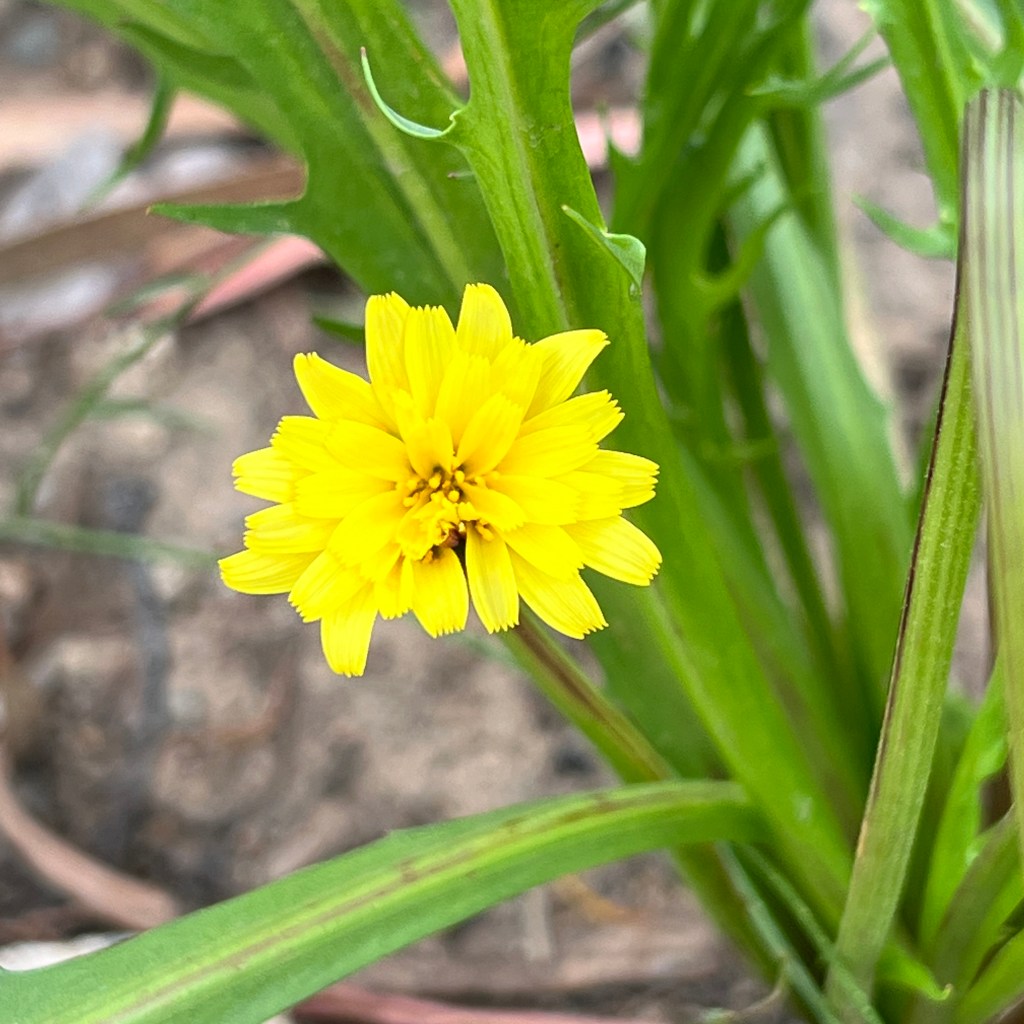
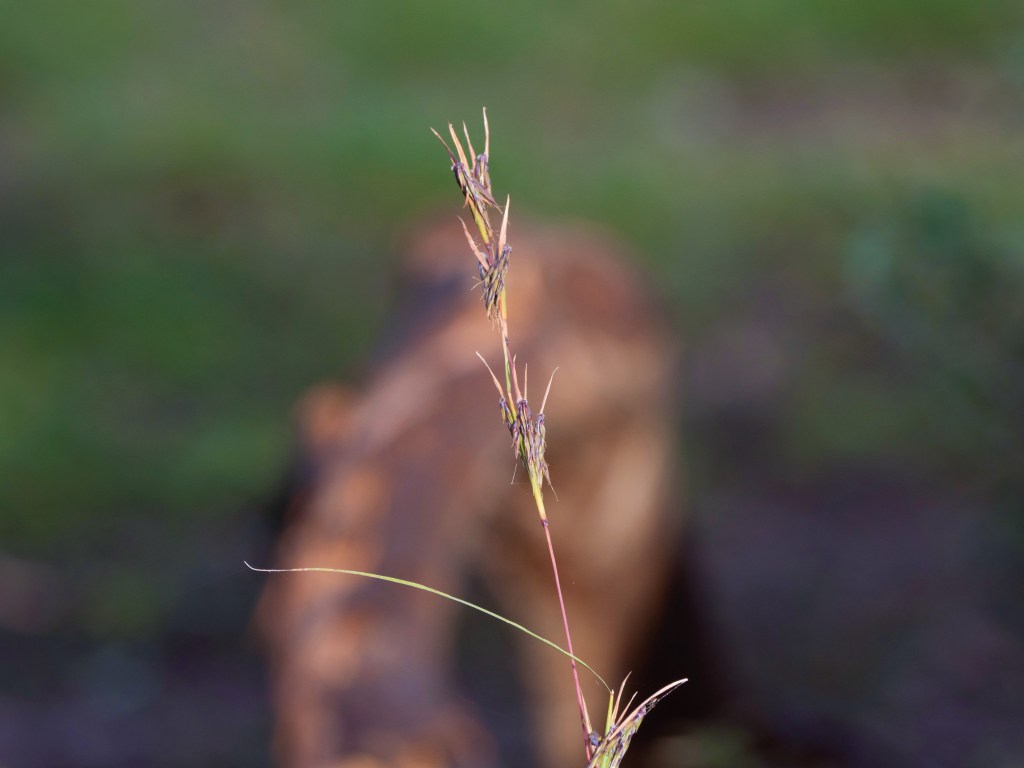
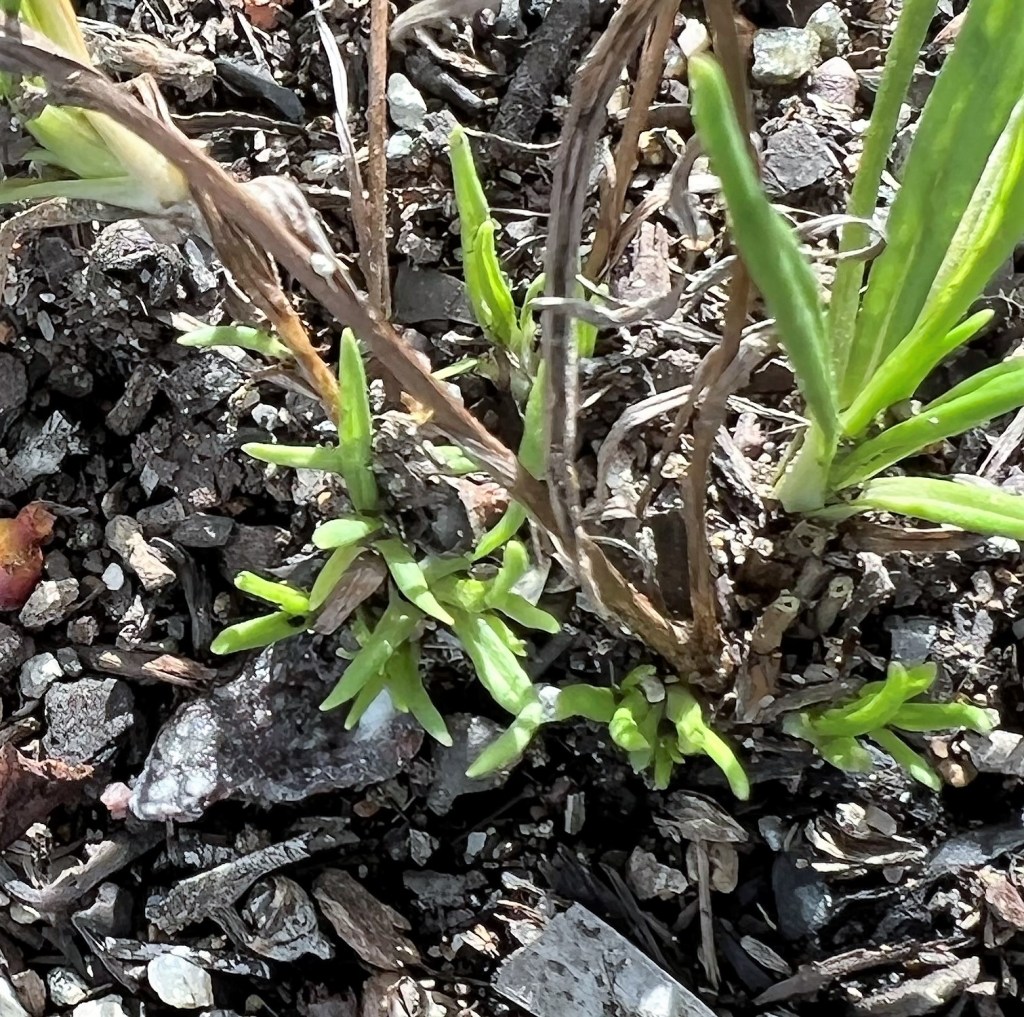
Ladies and gentlemen, I have been waiting with bated breath for the murnong (Microseris lanceolata) on my verge to bloom. I have been waiting much longer for a closed loop insulin delivery system that adjusts my insulin dose based on real time changes in my blood glucose level. Both have finally arrived.
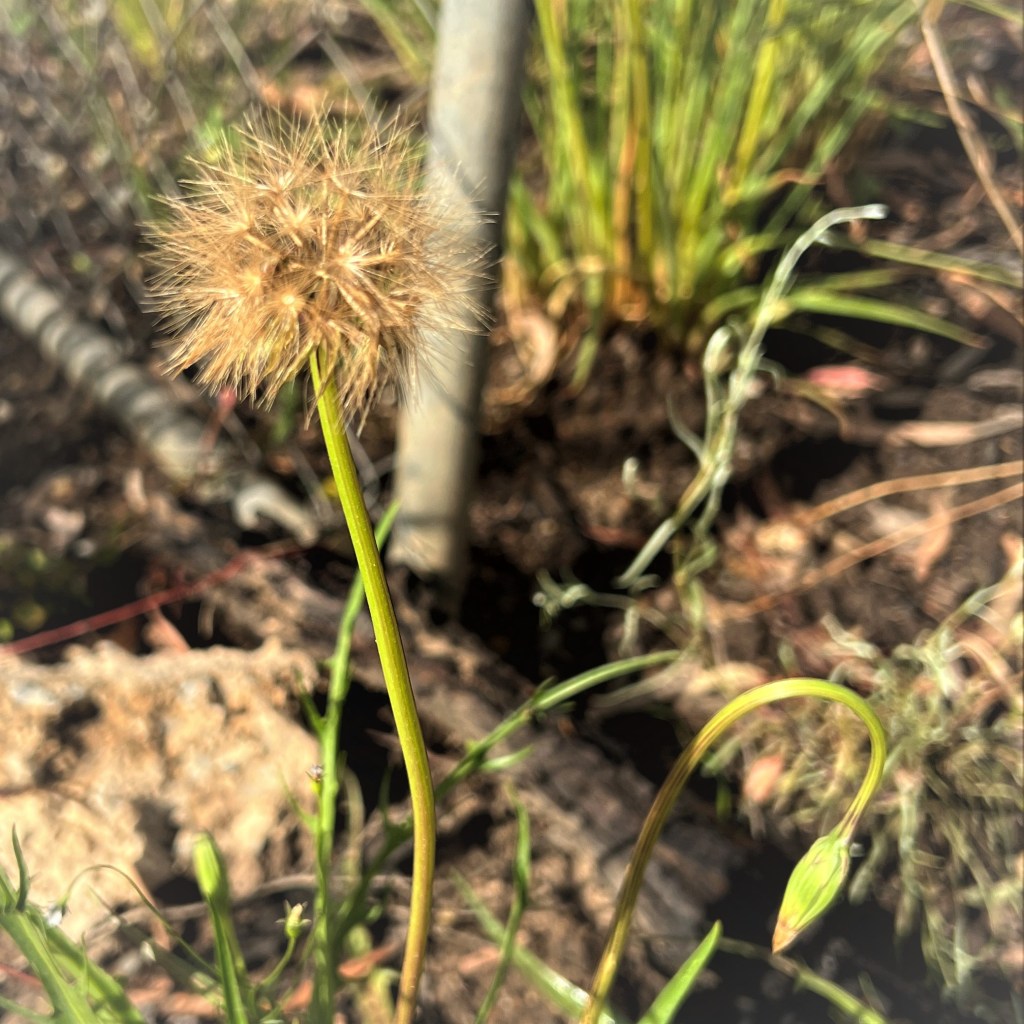
I have only been using the new tech for one week but already I feel that I am living life less on the edge. The tech suffers from a few technical glitches, but I can envisage a day in the near future when I can free my mind from the hundreds of decisions that normally go into the day to day management of my Type 1 diabetes. It may even change my temperament – perhaps I’ll be less cranky. Life too may offer a few more possibilities, just like this murnong seedhead.
It’s still Saturday somewhere, right? I’m a little uncomfortable about chucking in an entry because the Six On Saturday gardening contributors are very friendly and chatty, and of course, I am too, but my blogging program is giving me all sorts of problems and hence my communications are sparse, which doesn’t seem fair. Apologies in advance. But I have a few shots of my current fancy which is my verge garden, and it was Saturday here just a few short hours ago, so here goes.
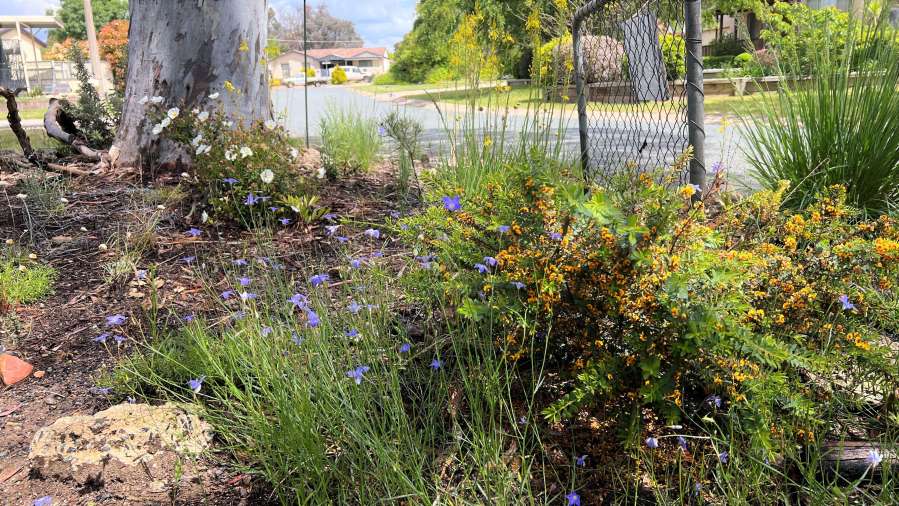
My bluebells (Wahlenbergia communis) have gone nuts this year. They are in their element here with other woodland and grassland plants. It helps that it has rained. A lot. There is a lot of yellow in the verge at this time of the year so the bluebells tone everything down.
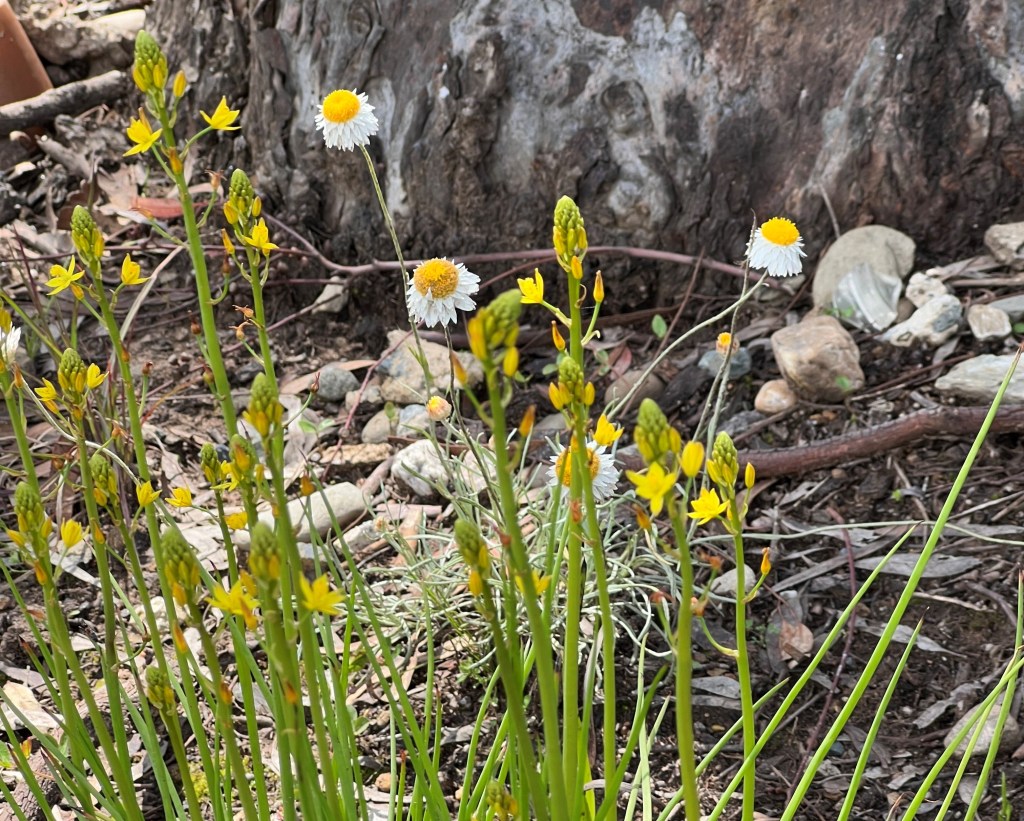
I’ve been learning a lot about what is a local plant over the last year. For example, from my perspective (and it will be different for you depending on where you live), plants can be native to Australia, native to the broader region surrounding Canberra, local to Canberra and/or local to my part of Canberra. When I first bought these native leek lilies (Bulbine semibarbata), I wasn’t au fait with all these intricacies. These lilies are not native to Canberra but grow in the broader region. Still, they are doing okay. The flower is tiny and not in focus. I was in a hurry and was too distracted by the lovely hoary sunrays (native to my part of Canberra and elsewhere) behind them. The latter must be the cheeriest flower of all time.
As you can see, the other bulbine lilies have bigger flowers. I don’t know whether these are Bulbine bulbosa or Bulbine glauca. I have both and I swear I was going to remember which was which but now I can’t. The bulbosa likes moist conditions while the glauca is a bigger, tougher beast and can cope with dry woodland.
The clustered everlastings (Chrysocephalum semipapposum) have just started to flower. They look a bit spindly because this is their first year.
The verge is meant to be a miniature grassy woodland so grass is a big feature, or it will be when the grasses grow. For some reason, I got distracted again and bought a number of different grasses. I don’t know whether they will all mesh together but I will soon find out. Here is some wallaby grass (Rhytidosperma sp.). You never know what you might end up with when you buy a non-specified species, but I am really happy with these cuties. They are only about 30cm tall. I really like them.
It seems that I am one photo short on the verge so I will finish off with a photo of this beautiful nepenthes which lives in a pot on our laundry window. It is as big as it looks. It prefers dusty, cobwebbed windows. You wouldn’t clean your window if you had to move this plant, although looking at them up close now, I can see the window needs a good scrub.
Jim Stephens from Garden Ruminations is the new host of Six On Saturday, a weekly challenge of all (six) things gardening. Pop along to Jim’s blog to see what’s in bloom at his house and in the gardens of the other participants.
Anyway, I had better go to bed now as I am exhausted from working on a mystery project. Hint, hint, it is plant related.
Talk soon if I can get the comments and the likes working (that’s blog speak for the information of you, non-bloggers).
I thought I might do some garden posts since, well, it cheers me up. Today I am making my second ever contribution to Six on Saturday, a weekly gardening get-together hosted by The Propagator. It has been a long time since my first post in May!
My new verge garden is looking a mess at the moment. Attractive features include rubble we dug out of the mud, mud splattered plants, and the bird cage and plastic containers protecting the vanilla lilies (Arthropodium milleflorum) from the marauding cockatoos. I understand that the tuber of the vanilla lily is a traditional bushtucker food. Aha! This got me thinking that perhaps I should go foraging for onion weed (Asphodelusfistulosus) which is another favourite of the cockatoos. They seem to know what is good eating. I discovered that yes, onion weed is edible. But I digress.
More pleasingly, the billy buttons (Craspedia variabilis) and the bulbine lilies (Bulbine glauca) are flowering ever so cheerily despite the spring rain.
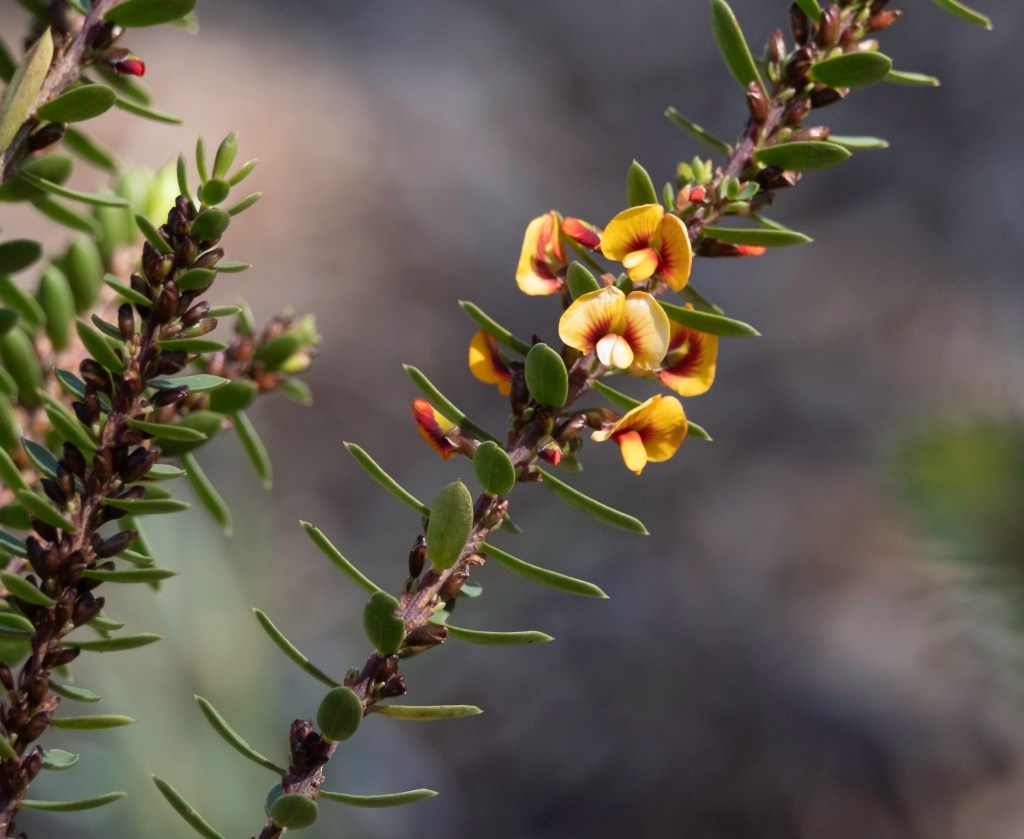
Next we have the egg and bacon plant (Eutaxia obovata) and tucked in along side it is Craspedia variabilis once again. The former is a West Australian shrub but doing quite well in sunny (just joking) Canberra on the opposite side of the country. The colours are best described as garish but the insects like them.
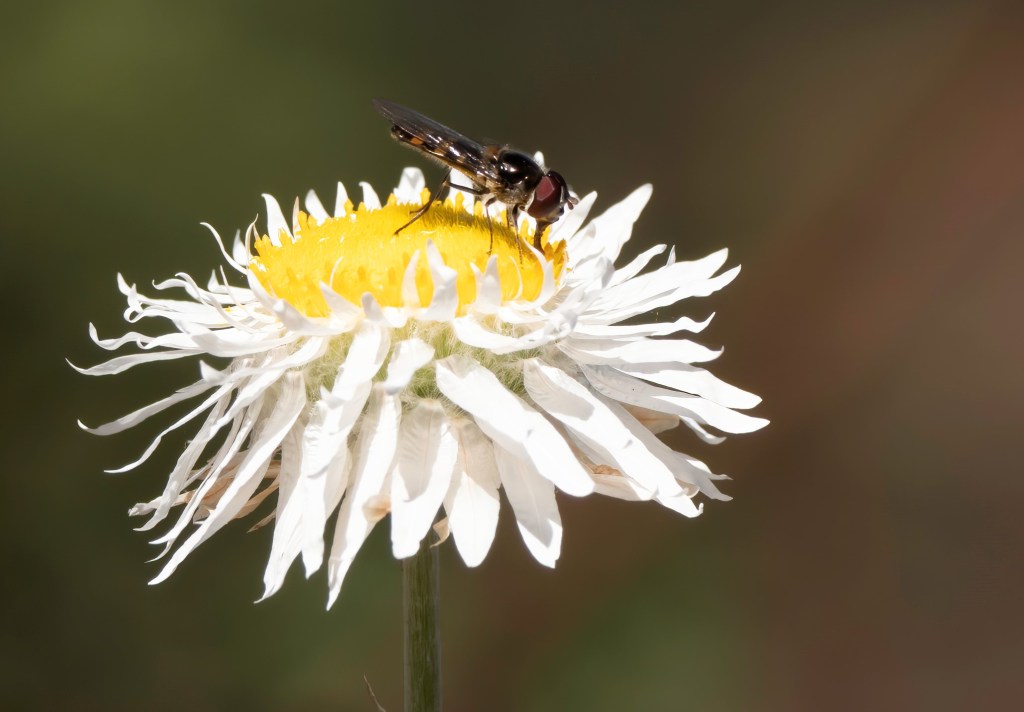
I have also included hoary sunray (Leucochrysum albicans) seedlings in the verge plantings. All are recent plantings except for two that I nursed through winter trying not to OVER WATER them! They are water-wise plants and don’t like to be waterlogged. The hoary sunray is a threatened grassland species local to our area. They look spectacular en masse but even a single plant is enough to brighten your day. Aussies, do make sure you get seedlings from a reputable plant nursery. All native plants on public land in Canberra are protected.
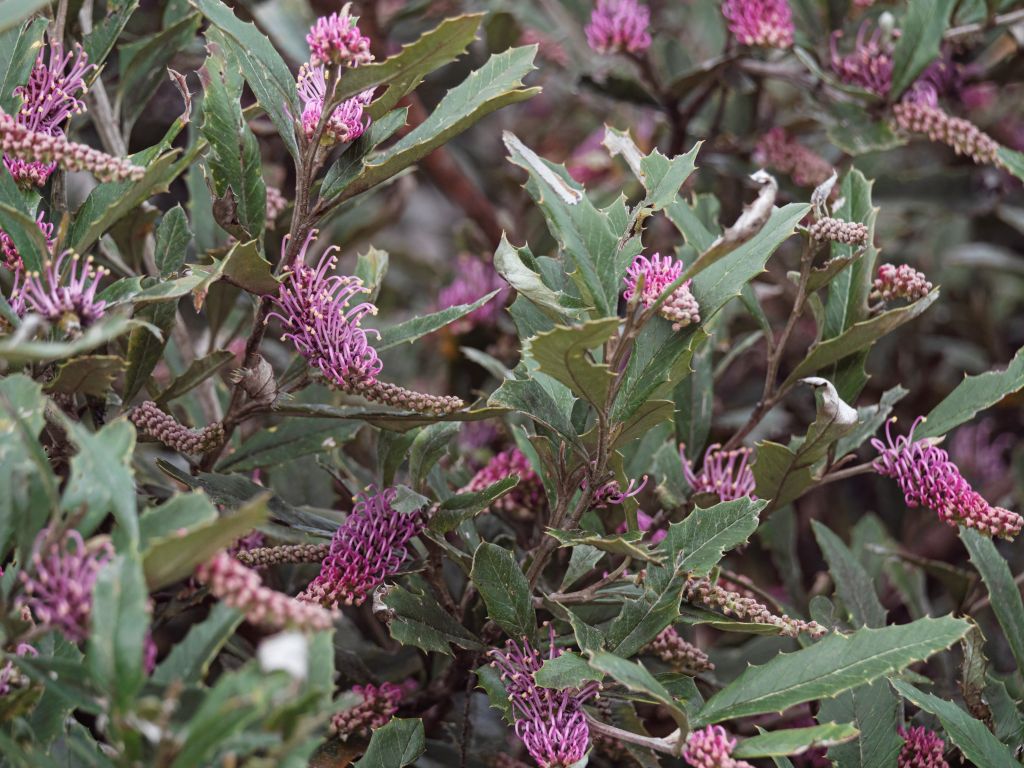
Come with me while I nip into the backyard. Our Tumut grevillea (Grevillea wilkinsonii) is flowering. The Eastern spinebills have already been into it despite it being a tad mouldy. Apparently, the flowers smell like mice urine. The geographic distribution of this species is restricted to a few small populations near Tumut in the western foothills of the Snowy Mountains, and unsurprisingly, it too is an endangered species. It is now being cultivated commercially and it does well in Canberra which has a not too dissimilar climate to Tumut. Anyway, I thought it deserved a photo just in case it doesn’t survive this extended wet spell.
Finally, let’s take a brief stroll to the local park. Because it is normally much drier, we don’t often get to see common woodruff (Asperula conferta) spreading in such delightful abandon. A small area of ecological significance has been fenced off and we are excited to see what else might pop up in that area over time.
You have probably guessed that it has been wet, wet, wet here in Canberra, Australia. Are you thinking what I’m thinking? Yes, we need a song because it is just that sweet little mystery that makes us try, try, try, try. Sing it with me, ladies and gentlemen.
Work on the verge, or the nature strip as some like to call it, began about a year ago. It began as a folly because our family normally call this area the dead zone. Growing a native garden under a gum tree can be difficult but hopefully not impossible with the right plant choices. We live in a frost hollow so that adds further challenges. It is winter now so not much is happening. Still, I am like an expectant mum, bursting with excitement and ready to bring home the baby. But as you know, these things cannot be rushed.
The design concept evolved over the course of the year from growing whatever would grow in the dead zone under our brittle gum, to instead targetting plants that were native to our local area (Canberra, Australia); there being quite a lot of overlap in these groups. Unfortunately my enthusiasm was not matched by my knowledge and so occasionally I planted some non-local native species in my haste to get plants in the ground before dry weather was upon us again. The definition of our local region is also very broad covering both sub-alpine temperate forests through to natural temperate grasslands on the plains.
The garden is finally starting to take shape, albeit mostly in my head. To narrow down my plant choices, I began to incorporate a number of species found growing in my nearby local park or plants that perhaps ought to be growing in the park if it had been left in its original natural state. I suspect I have over-planted but I anticipate some losses. By popular demand (a couple of people), below is a list of the plants I’ve jammed into this small space. This list and accompanying photos will be updated from time to time.
Grasses
Cymbopogon refractus (Barbed-wire grass) – despite its name, very soft and beautiful but highly flammable when mature. I may need to reconsider although that choice may have been made for me as it appears to have died over winter 2022.
Enneapogon nigricans (Nine-Awn grass, Bottlewashers) – a small, buxom grass.
Poa sieberiana (Small blue Tussock Grass) – beautiful.
Poa spp (Snow Grass) – I think I have Poa helmsii. Maybe too big? Doing fantastically well.
Rytidosperma spp. (Wallaby Grass)
Themeda triandra (Kangaroo Grass) – growing in nearby park and elsewhere in my garden.
Cymbopogon refractusThemeda triandra*Poa helmsii?
Climbers/Groundcovers
Billardiera scandens (Hairy Apple Berry) – local bush tucker.
Glycine clandestina (Twining Glycine) – growing in nearby park.
Convolvulus angustissimus – another species that occurs naturally at the park (where there are fewer snails!)
Hardenbergia violacea (Native Sarsparilla) – limited success previously but wrens seem to like it so I am trying again. Barely survived winter 2022.
Ziera prostrata – non-local threatened species. Unlikely to survive.
Glycine clandestina
Shrubs
Eremophila ‘Piccaninny Dawn’ – non-local but an eremophila that survives in Canberra! I’ll take it.
Eryngium ovinum (Blue Devil) – spiky but beautiful, dies back in autumn. Seen previously in nearby park but no longer present. Also elsewhere in my garden.
Rutidosis leptorrhynchoides (Button Wrinklewort) – endangered, heartbreaker, ie. difficult to grow. I’ve not had much growing it elsewhere in my garden.
Stylidium graminifolium (Grass Trigger Plant) – because I like them.
Thysanotus tuberosus (Common Fringe Lily)
Vittadinia muelleri (Narrow leaf New Holland Daisy) – growing in nearby park.
I thought I might do some garden posts since, well, it cheers me up. Today I am making my first contribution to Six on Saturday, a weekly gardening get-together hosted by The Propagator.
1. As some readers will know, I have been taking advantage of our extended La Niña event to establish a new garden with plants native to Australia on the front verge. The plants are tiny and as yet there is very little form or colour to the garden to give it depth and interest. So I whacked up this old gate that I had lying around out the back and hung my mosaic on it for the kids to enjoy when they walked past. The gate will also provide a frame for the climber, Appleberry, Billardiera scandens (not shown), that I have planted in front of the gate.
2. I have also planted a variety of native grasses in the new garden, including barbed-wire grass (Cymbopogon refractus) pictured above. A friend told me that barbed-wire grass is beloved of blue wrens and red-browed finches. I’ve not seen red-browed finches in our suburb so barbed-wire grass might be a grass to plant in our nearby reserve once we get rid of some of the dreaded African love grass.
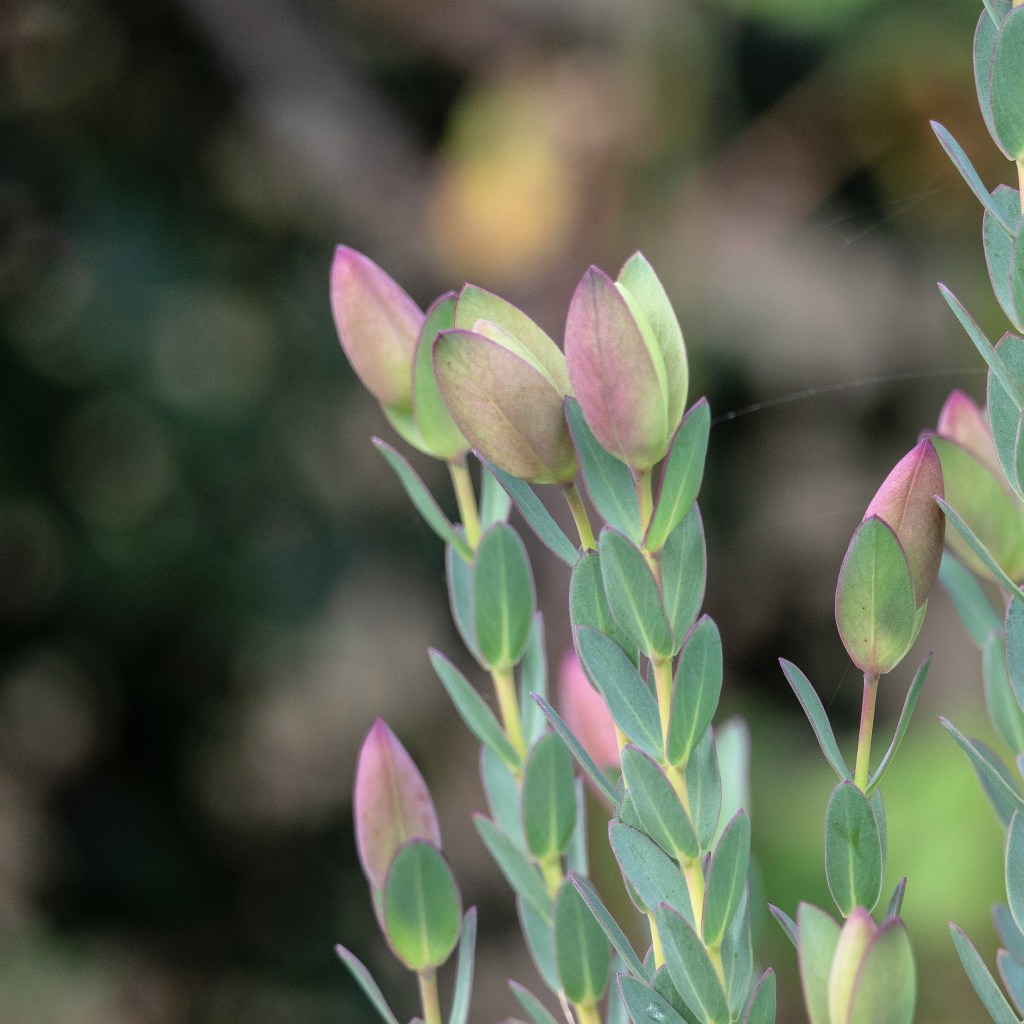
3. For the last few winters, the Australian National Botanic Gardens has been showing off Qualup Bells, Pimelea physodes. It grows in Western Australia. When I saw it at the local nursery, I couldn’t resist it and brought it home with me. This plant has been grafted making it possible to grow in Canberra (which is located in eastern Australia). Mine is planted in a pot. It is covered with buds that are poised to open (above). I can’t wait.
4. Speaking of pots, I took a cutting of the pink salvia, Salvia microphylla (above), growing out back. It is now established in this pot out front. The Eastern spinebills love it. Winter frosts will inevitably knock it back. When that happens, I hope the spinebills will be tempted by the Qualup Bells.
5. In the backyard, it is a shower of autumn leaves. This coral bark maple, Acer palmatum ‘Sango-kaku’ (above), has a few leaves that have not yet been washed away by today’s deluge. This tree was originally a rescue plant. We had to lop it as it did not have a central leader so it is unlikely to grow more than 3 or 4 metres. I really enjoy this tree, as do the little birds who swoop in to gather the fine sticky branches for nesting material.
6. And finally, a pink camellia (species unknown) peeks out from between the salvia and chocolate vine which are attempting to overwhelm it.
I recently decided that I would create a new native garden under my gum tree on the nature strip by the road, so I got to it by planting a multitude of tiny tubestock plants. Unfortunately the seedlings weren’t very easy to see and the kids passing by had a tendency to walk on them. My friends and I joked that I should install some stakes to deter the less observant. Before you all report to me to Child Services, I would like to reassure you that within moments of that thought, I began thinking of what I could put in the garden to make it more fun for the kiddies.
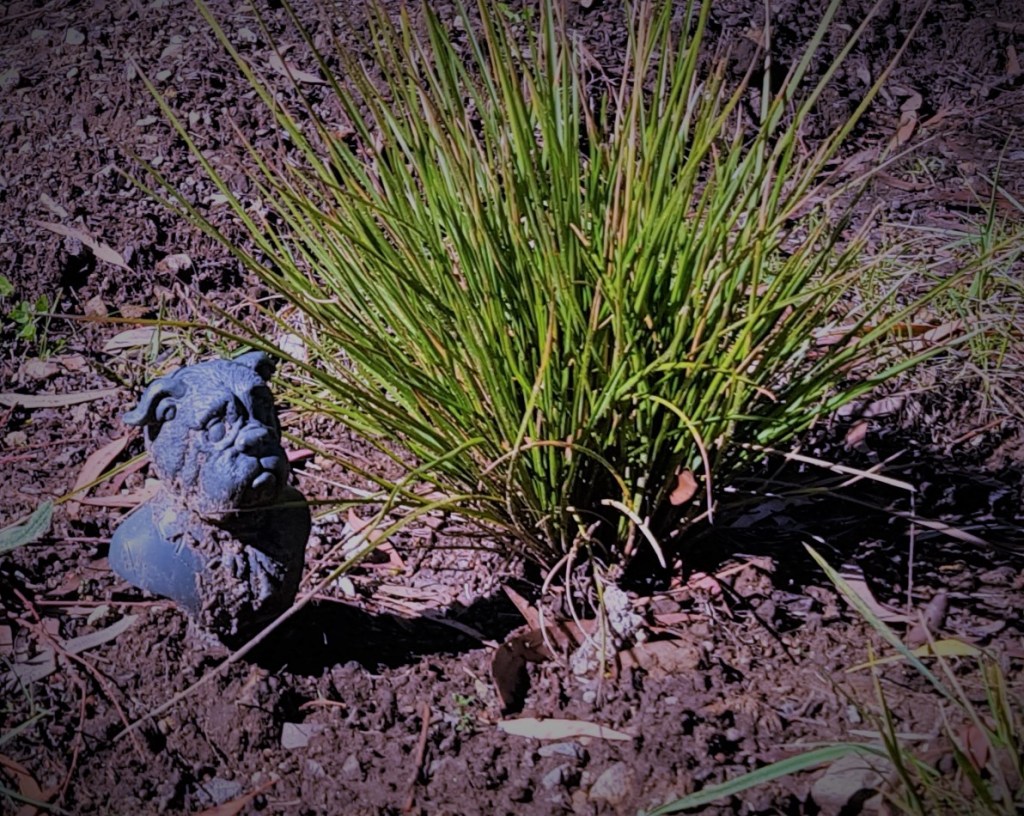
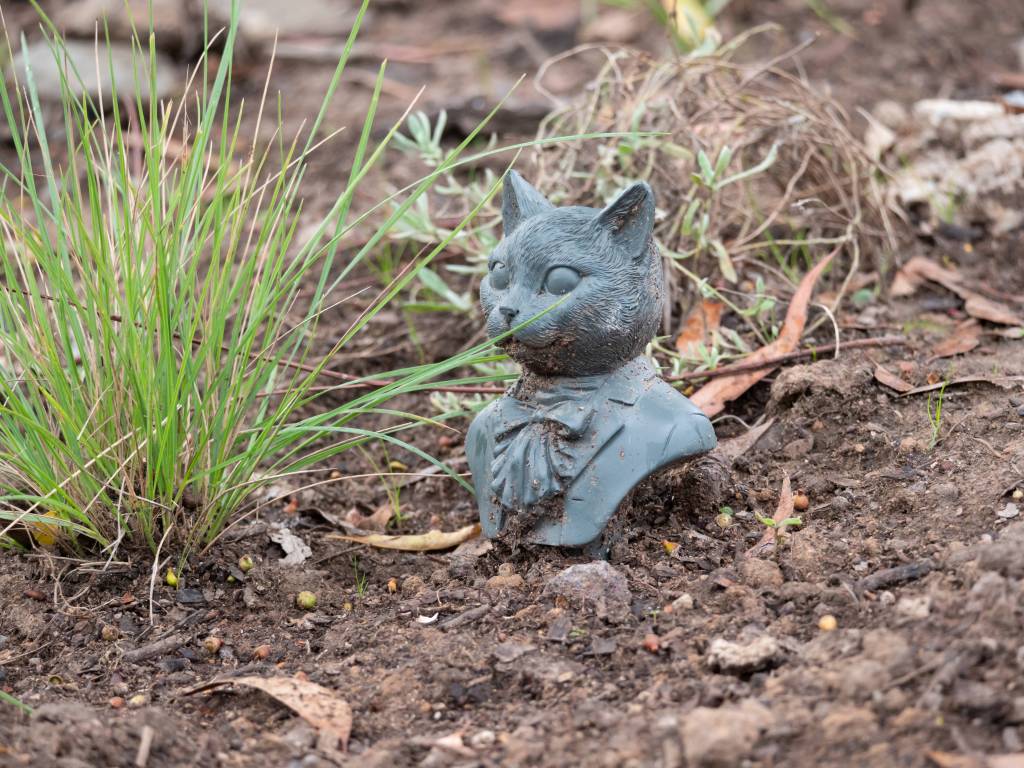
My son was going to throw out a couple of weird looking figurines that his grandmother had given him. Shhh, don’t tell grandma. So I rescued them and stuck them in the garden. Here’s one. I call it Gargoyle felis catus sp. I plopped it in next to a Poa sp. (an alpine grass).
I also found this neglected mosaic butterfly mosaic (not one of mine), complete with spider egg sac. Further information on spider egg sacs can be found here.
I then found an old dragonfly mosaic (one of mine) lying around so I put it on the other side of the tree until I can organise a stand for it.
It is coming together slowly. Hopefully it will look better when the grasses get a little bigger.
I am quite enjoying this preoccupation. I hope you are keeping busy too.















 Reflections of An Untidy Mind