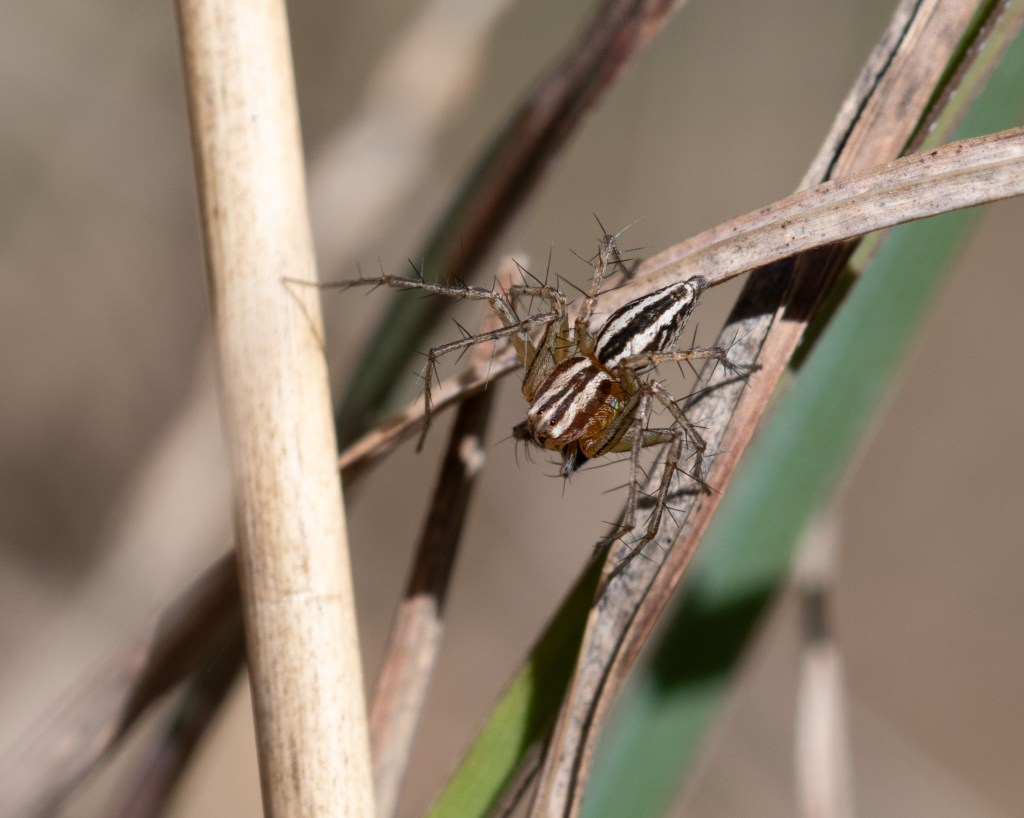
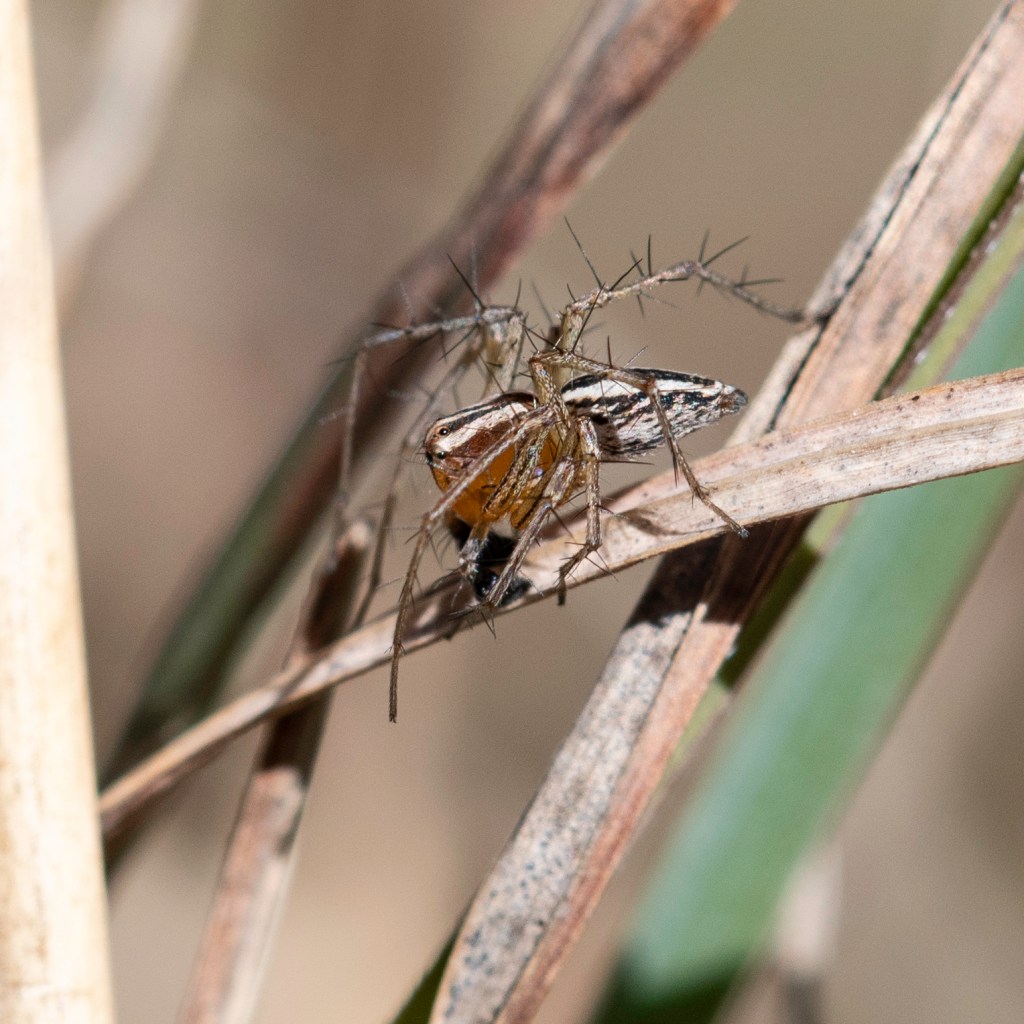
Dear Readers, please excuse this fooling around with photos. Apparently the colour management of my various photo editing software programs in relation to different browsers and various other confusing stuff is confusing. So I am experimenting. Blimey, as they say in the classics. Just ignore me. Or you could tell me whether the spider looks orange, brown and cream? Anyway, just in case you are interested, we think this is a some type of lynx spider. Have to get the colours right so we can ID it. Long story.
Kind Regards.
Tracy.
 Reflections of An Untidy Mind
Looks a pretty good photo to me!
LikeLiked by 1 person
Can you see much orange on the spider, Margaret? Do the colours look washed out?
LikeLiked by 1 person
Washed out? No. Orange, No not really. A certain tawniness in the second photo.
LikeLiked by 1 person
Thank you, Margaret. I will keep experimenting.
LikeLiked by 1 person
on my screen the ‘orange’ is very definitely a colour, but the rust colour of very rusty iron. What a pain in the proverbial, Tracy. I’m getting very sick of the wonder-technology (as in I wonder why we continue to have so much faith in the stuff). Very slippery all round.
LikeLiked by 1 person
Thanks, Tish. I wonder too and am constantly amazed that what worked a few days ago is then replaced by an enhancement that is less useful and friendly. Even office workers no longer seem to have in-house IT departments. No “wonder” productivity is declining.
LikeLiked by 1 person
Looks perfect to me Tracy. Orange, dark brown and cream-almost white. I think it also depends on our monitors. That is some spider. Blends into the background perfectly. Awesome photo.
LikeLiked by 1 person
Thanks, Anne. He is a beauty. I am learning about how to set up my monitor now. We are looking into monitor calibrators but I don’t think that will entirely fix the problem. Just so long as the photos look okay and don’t have the ghastly green hue that emerged with the latest software update. Getting there. 🙂
LikeLiked by 1 person
I’ve never seen a spider with such spiky legs before.
LikeLiked by 1 person
It is so interesting, isn’t it? I wonder what purpose those spikes serve?
LikeLiked by 1 person
Given my feelings about spiders, I don’t want to know!
LikeLiked by 1 person
These are only small ones, Liz. About 12mm.
LikeLiked by 1 person
🙂
LikeLiked by 1 person
I can see the orange really clearly in the second shot and a skunk like back in the first shot. Are those like thorns on the legs? Is this a poisonous spider?
LikeLiked by 1 person
Thanks, Heather. This is a male lynx spider. I read up on them today. They don’t use webs but rely on hunting/ambushing their prey. It is possible that the hairy legs help trap the insects that they feed on. Fascinating stuff, eh? 🙂
LikeLiked by 1 person
Very fascinating! Thanks for the info.
LikeLiked by 1 person
I don’t about the colors or what he’s supposed to be, but that is one cool spider.
LikeLiked by 1 person
It is a lynx spider, Martha. I wonder if those colours are lynx (ie. the cat) like? They don’t use webs to trap prey. They are hunting spiders and master of the ambush. They chase down their prey.
LikeLiked by 1 person
Lynx around here (two kinds) are not red. But I think there are different sub-species I don’t know. Bobcats are yellow/buff/gray with black spots. Canada Lynx are buff/gray. The Eurasian lynx is kind of red. I like the spines on that guy’s legs!!!
LikeLiked by 1 person
I had to google the Eurasian lynx. It is an impressive, stealth hunter.
LikeLiked by 1 person
I used to see a Bobcat on my hikes in the Laguna Mountains pretty often. She was wonderful. She did not care at all about me and the dogs. Once she crossed the trail in front of me and Jasmine and Lily. She had a ground squirrel in her mouth. I think she was heading to her den. We just watched her go. I swear she waved.
LikeLiked by 1 person
Blessed.
LikeLiked by 1 person
I was. The first time I saw her, she stopped in her tracks, froze, then sat down like she was saying, “Two big dogs and one woman, naw I’ll wait!”
LikeLiked by 1 person
Tracy–I am not the person to ask about spiders–just ask Brian! 😆 But this is one gorgeous photo. The front part (I’m guessing it’s the front) of the spider is a pretty amber color. The rest of the photo is various shades of beige/taupe/brown. Darn, those spikes on its legs are scary as all getout!
LikeLiked by 2 people
Think of it as a cat, Lois. That’s because it is a lynx spider. It doesn’t use a web to trap its prey but hunts them down or ambushes them.
You were brave to look at them close enough to see their colours.
LikeLiked by 1 person
I really don’t see that as Orange. More of a Rust color. Just my observation.
LikeLike
That seems to be the consensus. Thanks. Good to know that most people are generally seeing a similar tone, although in real life it is probably a little more orange.
LikeLiked by 1 person
I’ll go russet as well
LikeLiked by 1 person
Thanks, Brian. I’ll have to post the female next. She blends in a bit more.
LikeLiked by 1 person
On my new (2 month old) iMac desktop the insect’s body is rust-brown and the top has black and white stripes. That’s the close-up 2nd photo I’m talking about.
Back in 2012 when I changed from a Windows software to an Apple laptop with Dell 27″ high resolution screen, I had them arranged side-by-side. The colours between the two were very different so I used to try and ensure my photos were a sort-of-natural looking colour somewhere in between the Mac laptop and the Dell screen.
These days my iMac desktop is still very different in brightness and colour to my 13″ Mac Air (which I use mainly in hospital or when my iMac is playing up). Despite exactly the same settings on both.
I also tried to upload and blog early in the morning with natural daylight. (Ehrr that is, the rare time I upload a post these days). I still use my camera every day, even though I’m mostly housebound.
When I lived in a dark apartment back in 2015, one day I realised the exposure in nearly all my photos was incorrect. When I look back on those early photos, I have to (mostly) re-edit the exposure & colour slightly.
Going by the comments on this post, I think we are all seeing a rust or russet shade on the insect’s body. But definitely more brown in the top photo and a brighter rust shade in the second. The green leaf in the background looks slightly lighter in the second photo. The blurred branch or twig in the background is a warmer shade of brown in the second photo. Check out all parts of your image, not just the main (insect) subject.
I find the colour changes in insects, birds and flowers when you move in closer anyway, let alone the colour saturation which may, or may not, vary between different computers and different colour settings.
My Mac computers are always set on colour Adobe RGB (1998) by the way. Sorry for the long answer, but I thought my observations might be helpful to other readers as well as yourself.
LikeLiked by 1 person
Thank you for those very thoughtful comments, Vicki. I am sure they will help my other readers too. I will do a comparison of what you can see and with how it looks on my screen. I hadn’t considered how the lighting and time of day that I process photos might interfere with the quality of the processed photo. Thank you for pointing that out. I must confess that the idea of fathing around with calibrations, etc, fills me with horror, but I guess if I want to post my photos, and especially if I would like experts on citizen science apps to help with plant and animal/insect IDs, I will have to learn a little more about these colour management issues. Many thanks for sharing your expertise.
LikeLike
I spent hours, if not days, trying to calibrate the Dell screen back in 2012. I never succeeded in matching the Macbook Pro (which is the laptop I first bought) with the Dell monitor.
Despite my eyesight, I had an extraordinary ability to notice the small details way back in my working life and to some degree when I had to take early retirement and took up photography as a hobby.
Don’t worry too much about colour management issues. I’m sure the experts can identify the insect regardless of slight colour variations in photos. But I do highly recommend you do photo editing in the best daylight you can get. Downlights, fluorescent lights, lamps, study lamps, cool globes, warm globes – all affect your photos slightly. Also, try to get even light on all sides of your computer screen. Not an overhead light or a side light.
PS. I spent ages over the last 2 days trying to get a good shot of my resident Blackbird in the tree near the right-hand side of my balcony, even though a small branch always appears in front of the bird’s eye where he sits on a lower branch. I’ll get it in the end…..even if I have to buy a long-handled branch lopper and lean over the waist-high balcony to chop that tiny branch off. LOL.
LikeLike
Looking forward to seeing your blackbird, Vicki.
LikeLike
I’ve never seen anything quite like that critter before, and I’m OK with that! Ha!
LikeLike
Thank you. Spiders are much maligned.
LikeLike